
By Dan Rose, a Senior Local Business Guide Specializing in Dental Services in New York City
A missing molar at the back of the mouth is the easiest tooth in the world to ignore. Nobody sees it, chewing adapts within weeks, and the decision to do something about it slides quietly into next year.
What makes that costly is not the gap itself. It is that the gap changes shape over time, and the treatments available to you narrow as it does.
The gap has a name, and the name decides your options
Dentists do not describe missing teeth loosely. They use a classification devised by Dr. Edward Kennedy in 1925, and it is still the standard language for describing a partly toothed arch.
It sorts every case into four classes:
- Class I — bilateral free-ended: teeth missing at the back on both sides, with nothing behind the gaps
- Class II — unilateral free-ended: the same situation on one side only
- Class III — unilateral bounded: a gap with natural teeth standing on both sides of it
- Class IV — a single bounded gap crossing the front of the mouth
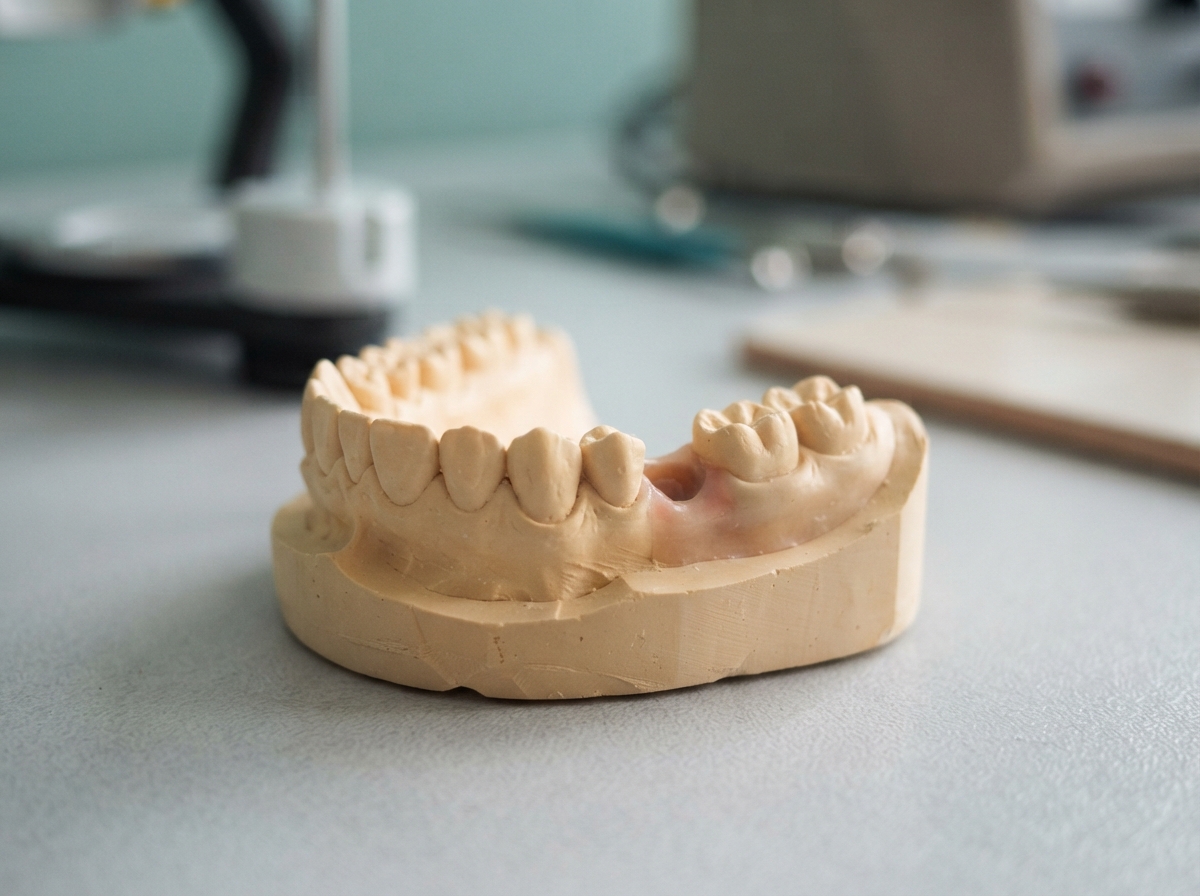
The distinction that matters to you is bounded versus free-ended. A bounded gap has a tooth at each end. A free-ended gap — also called a distal extension — has a tooth in front of it and open space behind.
That difference is not academic. A conventional bridge works by resting on a tooth at either end of the gap. A free-ended gap has only one end, so there is nothing for the back of a bridge to sit on, and a fixed bridge stops being possible.
Where a mouth has more than one gap, the additional spaces are recorded as modifications to the main class, a refinement added by Oliver Applegate. That is why two people can both be told they are Class II and be describing quite different mouths.
One more detail worth knowing: the class is decided by the most rearward gap being restored. So the backmost space in your mouth is the one setting the category, which is exactly the space people assume does not matter.
An example: one lower molar, and then two
Take a 52-year-old who loses the lower right first molar to a fracture. Behind it, the second molar is intact and healthy.
That is a gap with a tooth at each end — Kennedy Class III. Three routes are open: an implant, a three-unit bridge resting on the teeth either side, or a removable partial. Three real choices.
Four years later the second molar behind the gap fails too. Now there is nothing behind the space at all, and the case has moved from Class III to Class II.
Look at what that does to the bridge option arithmetically. A fixed bridge spanning this space needs an abutment tooth at each end: two required. With the back molar gone, there is one. The option does not get more expensive — it stops existing.
The removable option changes character too. A partial filling a bounded gap rests on teeth at both ends. A partial filling a free-ended gap has teeth at one end only, so the back of it is carried by the gum and the ridge underneath, which is a less stable arrangement and one that needs adjusting as the ridge changes shape.
The implant route survives the change, but it has also grown. One missing tooth has become two, and the ridge where the first molar sat has had four years to narrow, which is what turns a straightforward placement into one that may need grafting first.
The same four years cost nothing at the time. They removed one treatment option entirely and added a stage to another.
How common is this pattern?
More common than most people assume. The National Institute of Dental and Craniofacial Research, drawing on the National Health and Nutrition Examination Survey for 2017 to March 2020, reports that adults aged 20 to 64 have an average of 26 remaining teeth out of 32.
Six gone, on average, in the working-age population. Very few of those were lost all at once. They went one at a time, each loss making the next slightly more likely.
What moves when a tooth is not replaced?
Teeth are not set in concrete. They are held in a ligament that responds to force, and removing a tooth removes the forces that were holding its neighbors in position.
The tooth behind the gap tips forward. It leans into the space rather than moving bodily, which opens a wedge-shaped trap at the gumline where a toothbrush cannot reach.
The tooth above the gap comes down. With nothing to meet, the opposing tooth continues to erupt into the space. Eventually it can descend far enough to interfere with anything placed in the gap later, and correcting that means reducing or sometimes removing a perfectly healthy tooth.
The contact points open. As neighbors drift, the tight seals between teeth loosen and food begins packing into the spaces. That is both an irritation and a cause of decay in teeth that were previously sound.
The chewing load redistributes. The work the missing tooth was doing moves to the teeth that remain, which is why a crack or a failing filling often appears on the other side of the mouth a year or two after a loss on this one.
The ridge narrows. Bone that held a tooth root stops being loaded and remodels, so the ridge loses width and height. This is gradual, it is most rapid in the first year, and it is the reason a graft is sometimes needed before an implant can be placed into a site that has been empty for years.
Where this goes wrong
These are the recognizable ways the decision to wait turns expensive.
The wait was never actually a decision
Almost nobody decides to leave a gap permanently. They decide to leave it until something is more convenient, and then the appointment does not get made. Four years pass as a series of three-month postponements, and the clinical situation moves the whole time.
If you are going to wait, set a date to reassess it rather than leaving it open-ended.
Nobody mentioned the opposing tooth
Attention goes to the gap. The tooth descending into it from the other arch is at least as important, and it is the one most often ignored until it has moved far enough to constrain the treatment.
This is checkable at any routine appointment and takes seconds to look at.
The gap is treated as a cosmetic question because it is at the back
Front teeth get replaced promptly because the reason is visible in the mirror. Back teeth do the majority of the chewing and carry the majority of the load, and they are the ones whose loss changes the structure of the bite.
A second opinion was sought on price and not on timing
People shop treatment plans carefully and rarely ask the question that matters more: what changes if I wait a year. That question has a specific answer in your mouth, visible on your own radiographs, and it is the one worth asking.
The partial denture became permanent by default
A removable partial is a reasonable interim answer and a reasonable long-term one if it is chosen deliberately. Where it goes wrong is when it was meant to be temporary, nobody revisited it, and the ridge underneath carried on resorbing for a decade while the appliance got progressively looser.
Grinding was in the picture and nobody adjusted for it
If the teeth were already under heavy load, losing one redistributes that load onto fewer surfaces. Replacing the tooth without addressing the grinding puts the new work into the same conditions that contributed to the original loss.
What to ask at the consultation
Five questions that get to the position rather than the price:
- Is my gap bounded or free-ended, and does that rule anything out?
- Has the opposing tooth moved, and by how much?
- Have the neighboring teeth tipped, and does that affect what can be placed?
- How much ridge width is there now, and what would be needed for an implant?
- What specifically changes if I wait twelve months?
The last one is the question that separates a plan from a quote. A practice that has looked properly can answer it about your mouth rather than in general terms.
Common questions
Does a single missing back tooth really need replacing? Not in every case, and a dentist who says otherwise without examining you is overreaching. But it is a decision that should be made deliberately, with the drift and the ridge checked at each review, rather than by default.
How long can I leave it? There is no fixed deadline, which is precisely the difficulty. The changes are continuous rather than sudden, and the first year is when the ridge changes fastest. The honest answer is that the longer you leave it, the fewer routes remain open.
If a bridge is no longer possible, what is left? An implant, which does not depend on neighboring teeth, or a removable partial. Which is suitable depends on the ridge, the bite and your general health, and that needs imaging rather than a conversation.
Will the tooth above the gap really move? Often, though not always and not at a predictable rate. It is worth having it measured at reviews instead of assumed, because it is the change most likely to narrow your options without any symptom to warn you.
Can an implant still be placed after several years? Frequently yes, and a long-empty site is not automatically disqualifying. It does make grafting more likely, which adds a stage and extends the timeline, so the assessment should look at ridge dimensions rather than at how long the gap has been there.
Where to take this next
If you have a gap at the back of your mouth, the useful first step is not choosing a treatment. It is finding out which class your gap falls into and whether the teeth around it have started to move, because that determines what is still on the table.
Our page on how dental implant treatment works and what it costs sets out the process from consultation through to the finished tooth, and what drives the cost of implant treatment explains the factors behind the figures.
Pure Arts Dental Care
98-71 Queens Blvd, Rego Park, NY 11374 (on the Forest Hills border)
(718) 437-7777 · Monday–Friday, 9am–5pm
Request an appointment online
An assessment appointment answers the position question directly, and bringing any recent radiographs you already have makes it a shorter one.
This article is for general educational purposes and isn’t a substitute for an examination and personalized advice from your dentist. Sources: Kennedy classification of partially edentulous arches, first proposed by Dr. Edward Kennedy in 1925. Tooth loss figures from the National Institute of Dental and Craniofacial Research, drawn from the National Health and Nutrition Examination Survey, 2017 to March 2020.

 Call Now