
Losing a single tooth is one of those things that feels manageable right up until you have to decide what to do about it. You can still chew. You can still smile, mostly. And then your dentist hands you two options — a dental implant or a bridge — and the decision suddenly feels a lot bigger than one tooth.
Both work. Both have been used for decades. But they solve the problem in genuinely different ways, and the right answer depends on the tooth, the bone underneath it, the teeth on either side, and how long you want the result to last. Here’s how they actually compare.
The short answer
If the teeth on either side of the gap are healthy and untouched, a single implant is usually the better long-term investment. It replaces the root as well as the crown, it leaves the neighboring teeth alone, and it protects the bone in that part of your jaw.
A bridge makes more sense when the adjacent teeth already need crowns anyway, when there isn’t enough bone for an implant and grafting isn’t an option, or when you need the gap closed quickly.
That’s the summary. The reasoning is worth understanding, because it’s your jaw for the next thirty years.
What each option actually is
A single dental implant
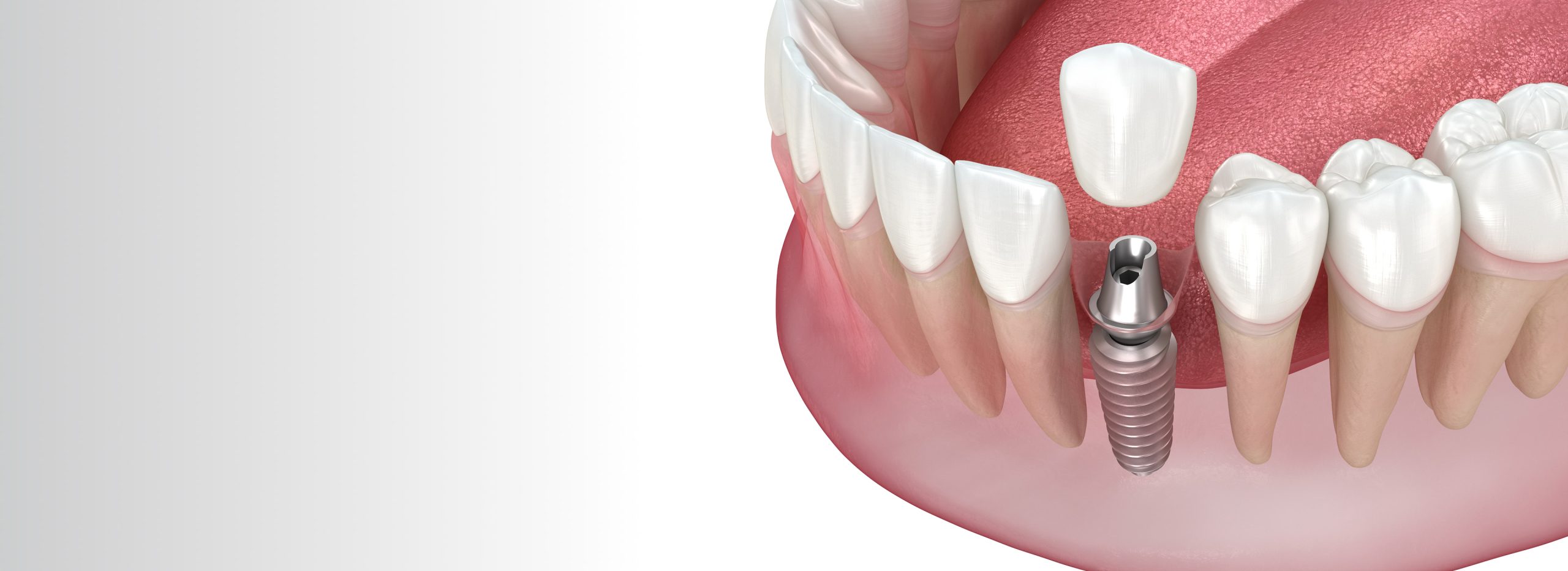
An implant is a small titanium post placed into the jawbone where the root of your missing tooth used to be. Over the following months the bone grows around and bonds to it — a process called osseointegration — which is what gives an implant its stability. Once it’s fused, an abutment is attached and a custom crown goes on top.
The result is a standalone tooth. It doesn’t touch, lean on, or depend on anything next to it.
A dental bridge
A bridge closes the gap using the teeth on either side as anchors. Those two teeth are reduced in size and fitted with crowns, and a replacement tooth is suspended between them — three connected units where you previously had one gap.
Nothing goes into the bone. The bridge rests above the gum line and is supported entirely by the neighboring teeth.
The five differences that actually matter
1. What happens to the bone underneath
This is the difference most people don’t hear about, and it’s the most important one.
Jawbone is maintained by pressure. Every time you bite, the tooth root transmits force into the bone, and the bone responds by staying dense. Remove the root, and that stimulation stops. The bone in that spot begins to resorb — it thins and shrinks over the years that follow.
An implant restores that stimulation, because it functions like a root. A bridge doesn’t. Under a bridge, the bone keeps quietly receding, which is why a bridge placed at 40 can look subtly different at 55 — a small shadow or dip appearing under the replacement tooth as the ridge beneath it flattens.
If your missing tooth is toward the front of your mouth, this matters cosmetically as well as structurally.
2. What happens to your neighboring teeth
To place a bridge, enamel has to be removed from the two anchor teeth. If those teeth are already crowned, damaged, or heavily filled, that’s no real loss — they needed work anyway, and the bridge does two jobs at once.
But if they’re healthy, virgin teeth, you’re permanently altering two sound teeth to replace one missing one. Enamel doesn’t grow back, and crowned teeth carry a slightly higher long-term risk of needing root canal treatment later.
An implant leaves both of them untouched.
3. How long each one lasts
A well-placed implant post is designed to be permanent. Research consistently reports survival rates above 95% at ten years, and many implants function for decades beyond that. The crown on top may need replacing eventually, like any restoration — but the post itself typically stays put.
A bridge has a shorter working life. Most last somewhere in the range of ten to fifteen years before needing replacement, and the usual reason isn’t the bridge itself — it’s decay or fracture developing in one of the anchor teeth, where the crown margin meets the natural tooth. When an anchor tooth fails, the whole bridge has to come off, and sometimes the replacement bridge has to be longer than the original.
4. Cost — upfront versus over time
A bridge costs less at the start. There’s no surgery, no healing period, no post.
An implant costs more upfront but often costs less across twenty or thirty years, simply because it’s less likely to need redoing. A bridge replaced twice in that window can quietly overtake the implant it was chosen to avoid.
The honest way to think about it: compare the cost of the next thirty years, not the cost of this month. If the upfront number is the obstacle rather than the treatment itself, that’s a solvable problem — we walk through what drives implant cost and offer flexible financing through Cherry, which takes a couple of minutes to apply for and involves no hard credit check.
5. How long treatment takes
This is where a bridge genuinely wins. A bridge is usually finished in two or three weeks.
An implant takes longer, because bone integration can’t be rushed. Expect a few months from placement to final crown in most cases, sometimes longer if a graft is needed first. You’re rarely walking around with a visible gap during that time — a temporary restoration covers the space — but the total timeline is measured in months, not weeks.
If you have a wedding in six weeks, say so at your consultation. It changes the plan.
When a bridge is the better choice
A bridge is often the right call when:
- The teeth on either side already need crowns, so no healthy enamel is being sacrificed
- There isn’t enough bone to support an implant and grafting isn’t practical or wanted
- A health condition or medication makes minor oral surgery inadvisable
- You need the gap closed on a firm, short deadline
- The upfront cost is the deciding factor and financing isn’t an option
None of these are consolation prizes. A well-made bridge on well-chosen anchor teeth is a solid, comfortable restoration that people wear happily for years.
When an implant is clearly worth it
An implant tends to be the stronger choice when:
- The neighboring teeth are healthy and you’d rather not touch them
- The missing tooth is at the back, where chewing forces are highest
- You want to protect the bone and the shape of your face over the long run
- You’re planning for decades rather than years
- You’d rather floss normally than thread floss under a bridge every day
What the implant process looks like at our Rego Park office
We start with an exam and 3D imaging so we can see exactly how much bone is there and where the nerves and sinuses sit. That scan is what tells us whether you’re a straightforward case, or whether you’d benefit from a bone graft first — common for upper back teeth, where the sinus sits close above the roots.
Placement itself is a short appointment under local anesthetic, and most patients are surprised by how manageable it is. Discomfort afterward is usually well handled with over-the-counter pain relief. Then the bone does its work over the following months.
The final crown is where our setup differs from most practices: we have a complete in-house lab in the office, including milling. We design and make your crown here rather than shipping impressions to an outside dental laboratory. That means shorter turnaround, fewer appointments spent waiting on a lab, and shade and shape adjustments made on the spot with you in the chair instead of over a two-week postal loop — and because we’re not paying an outside lab, we can keep the cost of the restoration lower than practices that outsource.
Missing more than one tooth?
The comparison changes once you’re replacing several teeth. Two or three missing teeth in a row may be better served by an implant-supported bridge — two implants carrying three teeth — rather than individual implants for each.
And if you’re missing most or all of the teeth in an arch, neither of these options is the right conversation. That’s full arch implant treatment, where a set of implants supports a complete fixed arch of teeth. It’s a different procedure with a different set of trade-offs, and it’s worth reading about separately alongside your other options for replacing missing teeth.
Common questions
Does getting a dental implant hurt? The placement is done under local anesthetic, so you shouldn’t feel pain during the procedure itself. Most patients describe the recovery as milder than they expected — comparable to a tooth extraction, and usually managed with over-the-counter pain relief for a few days.
How long can I wait before replacing a missing tooth? Sooner is better. Bone loss begins in the months after a tooth is lost, and the neighboring teeth start to drift toward the gap, which can change your bite. Waiting doesn’t just delay the fix — it can make the eventual fix more complicated and more expensive.
Will my insurance cover an implant or a bridge? Coverage varies a great deal between plans. Many plans contribute more readily toward a bridge than an implant, though that’s been slowly changing. Bring your plan details to your consultation and we’ll check what applies before you commit to anything.
Can I have an implant if I’ve been missing the tooth for years? Often yes, but the bone will have thinned in that time. A scan tells us whether there’s enough volume to place an implant directly, or whether a graft or sinus lift is needed first to rebuild the site.
How do I clean each one? An implant is brushed and flossed like a natural tooth. A bridge needs floss threaded underneath the replacement tooth daily — it’s not difficult, but it is a habit you have to keep, because decay under a bridge anchor is the most common reason bridges fail.
Is a bridge ever better than an implant? Yes — genuinely. When the anchor teeth already need crowns, when bone is insufficient, or when time or cost rules out surgery, a bridge is the better treatment. Anyone who tells you implants are always the answer is selling implants, not dentistry.
Let’s look at your specific case
The right answer here depends on things you can’t judge from an article — how much bone is under the gap, what condition the neighboring teeth are in, how you bite. A consultation and a 3D scan will settle it in one visit, and you’ll leave knowing what each option would actually cost and take.
Pure Arts Dental Care
98-71 Queens Blvd, Rego Park, NY 11374 (on the Forest Hills border)
(718) 437-7777 · Monday–Friday, 9am–5pm
Request an appointment online
Want to read further first? Our dental implant guide covers the procedure and costs in detail, and our implant FAQs answer the questions patients ask most often.
This article is for general educational purposes and isn’t a substitute for an examination and personalized advice from your dentist.

 Call Now