 (718) 437-7777
One missing tooth is the most common implant case we treat, and the most straightforward. A single implant replaces the root, a custom crown replaces the visible tooth, and nothing else in your mouth is touched.That last part is what separates it from every other option. Here is how it works, what it takes, and what to expect at our Rego Park office.
How a single tooth implant works
What a single tooth implant actually is
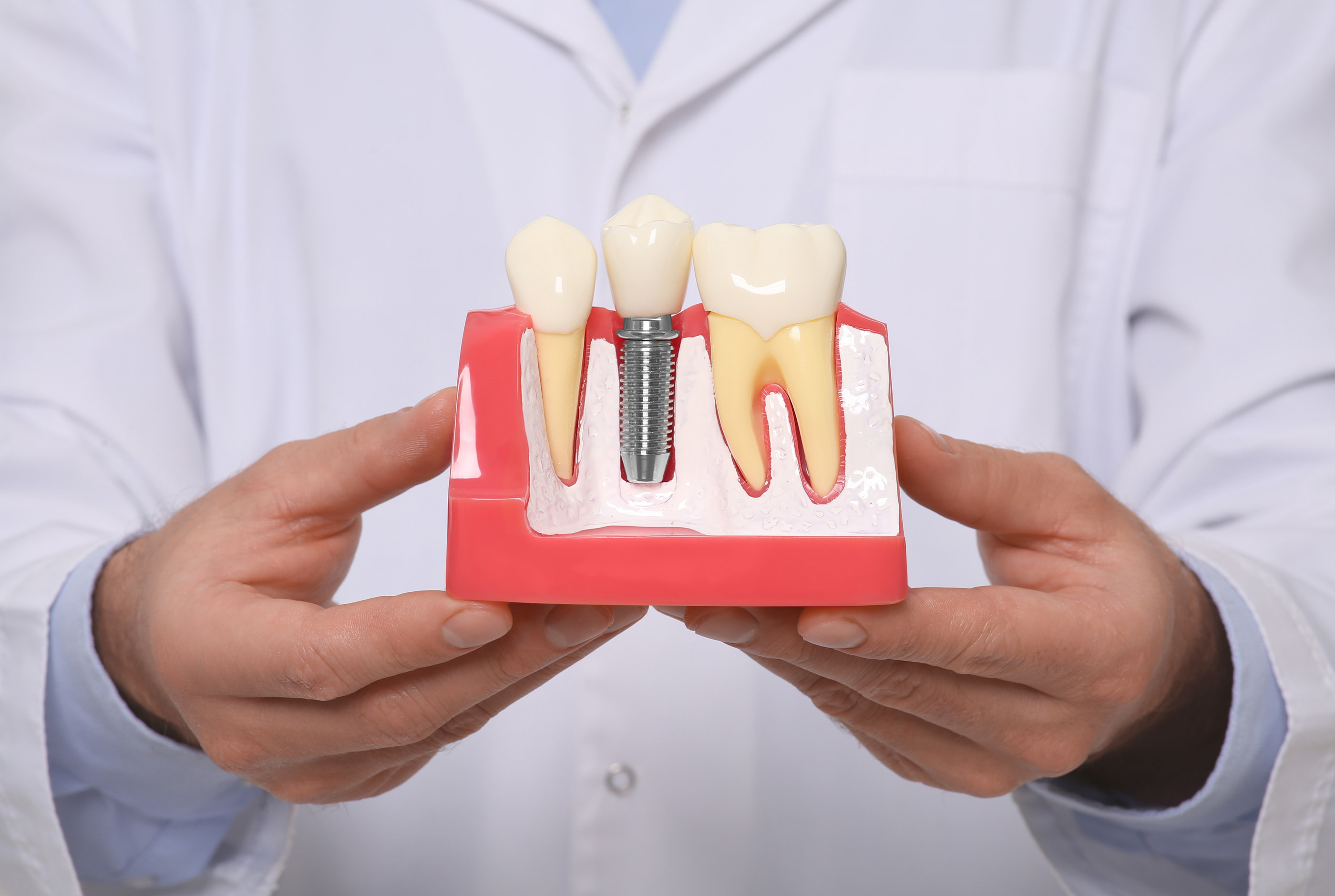
A single tooth implant is built in three parts, placed in stages. Once finished it functions as a standalone tooth — you brush it, floss it and bite with it exactly as you would a natural one. It does not lean on the teeth beside it, and they carry none of its load.
The implant — a small titanium post placed into the jawbone where the root used to be
The abutment — a connector fitted to the post once it has fused with the bone
The crown — a custom-made tooth, matched to the shade and shape of the teeth around it
Why the root matters more than the crown
It is easy to think of a missing tooth as a cosmetic gap. Underneath, something more gradual is happening.
Bone is maintained by pressure. Each time you bite, the tooth root transmits force into the jaw, and the bone responds by keeping its density. Remove the root and that signal stops. The bone in that spot slowly resorbs, thinning and shrinking over the years that follow.
An implant is the only replacement that restores that stimulation, because it is the only one that replaces the root. A bridge or a partial denture sits above the gum line and leaves the bone beneath it unloaded. It is also why neighboring teeth drift toward an untreated gap and the opposing tooth over-erupts into the space — waiting does not just delay the fix, it can make the eventual fix more involved.
Implant or bridge?
Both are legitimate treatments, and a bridge is genuinely the better choice in some situations — particularly when the teeth either side already need crowns.
The short version: if the adjacent teeth are healthy and untouched, an implant avoids permanently altering two sound teeth to replace one missing one. If they already need work, a bridge does two jobs at once.
We have written the full comparison — bone loss, lifespan, cost over time, treatment length — in dental implant vs. bridge. Our page on options for replacing missing teeth covers the wider set, including partial dentures.
The process, visit by visit
The whole sequence usually runs over several months, because bone integration cannot be hurried. You are not left with a visible gap during that time — a temporary restoration covers the space where appearance matters.
Consultation and 3D scan — we check bone volume, bone density, and the position of nerves and sinuses before any commitment
Extraction, if the failing tooth is still there — sometimes the implant goes in at the same appointment, sometimes the site heals first
Implant placement — a short appointment under local anesthetic, with recovery generally comparable to an extraction
Healing and integration — the bone grows around and bonds to the implant over the following months
The crown — impressions, abutment, and the final custom tooth fitted
Where our in-house lab makes the difference
The final crown is where our setup differs from most practices. We have a complete in-house lab in the office, including milling. Your crown is designed and made here rather than shipped to an outside dental laboratory.
That means fewer appointments spent waiting on a lab, and — more importantly for a front tooth — shade and shape adjustments made on the spot with you in the chair, instead of over a two-week postal loop.
Who is a good candidate
Most adults with a missing or failing tooth are. Age is rarely the deciding factor; bone quality and gum health are. The things that actually matter:
Bone volume at the site — a scan tells us, and grafting or a sinus lift can often solve a shortfall
Healthy gums — active gum disease is treated before implant placement, not alongside it
Smoking — it measurably lowers success rates, and stopping around the procedure helps considerably
Well-managed general health — conditions like diabetes are not a barrier when controlled
Grinding — treatable, but worth identifying up front so the restoration is protected
Looking after it
Brush twice a day and floss around it like any other tooth. Implants cannot decay, but the gum and bone supporting them can become inflamed if plaque is allowed to build at the margin — a condition called peri-implantitis, and the main reason implants fail years after placement.
Keep your regular checkups. A well-maintained implant can last decades.
What affects the cost
The main variables are whether an extraction is needed, whether the site needs grafting or a sinus lift, the type of crown, and the complexity of the position. A straightforward premolar and a front tooth needing precise shade matching are not the same job.
We break down the full picture on our implant cost factors page, and Cherry financing lets you spread payments with no hard credit check.
Missing more than one tooth? Two or three in a row may be better served by an implant-supported bridge, and if most or all of an arch is gone, full-arch implant treatment is the relevant option.
Common Questions
How long does a single tooth implant take?
Usually several months from placement to final crown, because bone integration cannot be hurried. If grafting is needed first, longer. You will have a temporary restoration during that time where appearance matters.
Does getting a single tooth implant hurt?
Placement is done under local anesthetic, so you should not feel pain during the procedure. Recovery is generally milder than patients expect — comparable to a tooth extraction, and usually managed with over-the-counter pain relief for a few days.
Will the crown match my other teeth?
That is the part our in-house lab is best suited to. Shade matching is done with you present and adjusted immediately if it is not right, rather than being decided from a photograph sent to an outside laboratory.
How long does a single dental implant last?
The post is designed to be permanent, and research consistently reports survival rates above 95% at ten years, with many lasting far longer. The crown may eventually need replacing, as any restoration might.
Can I have an implant if the tooth has been missing for years?
The post is designed to be permanent, and research consistently reports survival rates above 95% at ten years, with many lasting far longer. The crown may eventually need replacing, as any restoration might.
Is an implant better than a bridge?
Not always. If the teeth either side already need crowns, a bridge does two jobs at once and is the better treatment. If they are healthy and untouched, an implant avoids permanently altering two sound teeth to replace one missing one.
Book a consultation
One visit and a 3D scan will tell you whether you can proceed straight away, what the treatment would involve, and what it would cost — no guesswork from an article.
Pure Arts Dental Care — 98-71 Queens Blvd, Rego Park, NY 11374, on the Forest Hills border. Call (718) 437-7777, Monday to Friday, 9am to 5pm.
Related reading: our dental implant guide covers the procedure and costs in detail, and our implant FAQs answer the questions patients ask most often.

 Call Now